
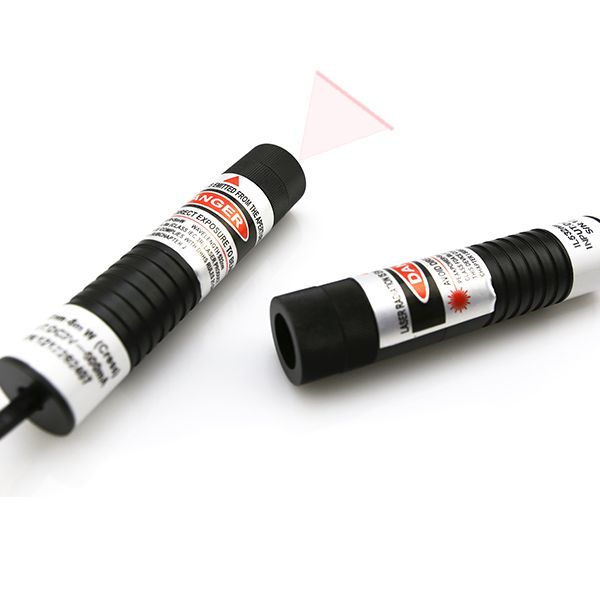
What is a good solution for engineers and factory workers to make ultra clear and fine line indication for those of industrial inspection works? It is not workable at all to only rely on prior line drawing or printing work, not any longer limited by long distance, high height and other complex working environments etc, it always makes a good job to apply a long wavelength made device of a 980nm infrared line laser module. It is primarily used in industrial inspection for non contact line scanning, high precision dimensional measurement, detect or contour detection, and 3D reconstruction. Whenever it gets constant electric power source supply and proper use of output power and optic lens fan angles, this assistance part of IR laser line generator enables high precision, no visible interference and stable IR line projection for all online quality inspection works.
Unlike prior line drawing or printing work, the usual use of a 980nm infrared laser line generator gets no limitation by long distance, high height or other complex working environments as well. It applies an import 980nm infrared laser diode within 5mW to 500mW and high power up to 600mW to 1000mW. Being made with a metal heat sink cooling system inside a durable anodized aluminum alloy housing tube, it gets superior nice heat dissipation, and ultra stable infrared reference line projection in long term use. When IR laser line generator projects highly straight and fine infrared reference line, together with it small laser beam divergence fan angle of less than 2mrad. It is resulting in a positioning accuracy of ±0.1–±1mm, far superior to ordinary infrared LED line light sources, suitable for precision detection.
Configured with a glass window in front of laser beam aperture, 980nm infrared laser line generator can tolerate any harsh occasion of moisture, dust, rain, water or fog etc. 980nm is near infrared invisible light, resistant to sunlight and ambient light interference, and remains stable in outdoor/strong light environments. 980nm infrared laser light does not affect the human eye or visual systems, and there is no red glow. After its easy integration with any industrial inspecting machine or equipment, the infrared alignment laser line has high energy density, maintaining a stable line shape over distances of several meters to tens of meters, reducing transmission loss, and suitable for long distance line positioning and detection.
Applications in industrial inspections:
Surface and Contour Line Scanning: Detection of defects such as scratches, dents, bulges, and cracks in materials such as metal, plastic, and glass; measurement of flatness, edge straightness, width/thickness/gap of coils/sheets/films; achieving high-speed online inspection with infrared line scan cameras, uniform line width, and compatibility with continuous production lines.
High-Precision Dimensional and Gap Measurement: PCB/FPC board edge positioning, electronic component pin spacing/height measurement, mechanical part groove width/step difference detection; the line laser has a small divergence angle (typically ≤2mrad), a line width ≤1mm at 1 meter, and a positioning accuracy of **±0.1–±1mm**, replacing manual calipers/micrometers and improving efficiency by more than 10 times.
3D Contour and Volume Reconstruction: Based on the triangulation principle, used for 3D profilometers, industrial LiDAR, and volume/inventory scanning of material bins/shelves; compatible with AGV/AMR navigation, workpiece pose recognition, and glue/welding path guidance, quickly generating high-density point cloud data.
Special Material and Hidden Defect Detection: Photovoltaic cell PL imaging (hidden cracks, dirt, graphite boat marks), internal defect scanning of transparent plastics/dark metals, semiconductor wafer edge/chipping detection; the 980nm near-infrared light has strong penetration power, and can capture internal structural anomalies when combined with an infrared camera.
Equipment and Sensor Calibration: Infrared camera/line array detector field of view calibration, line laser sensor calibration, infrared optical system optical path debugging, providing a standard near-infrared light source to ensure detection consistency.
